

Many of the information may equally be applicable to owners of units in a sectional title scheme, and other persons, but this blog post focusses more on factors that trustees, the executives of a sectional title scheme, must keep in mind when electrical work is to be done on common property.
First, a look at the Functions of the Body Corporate, as set out in section 3 of the Sectional Titles Schemes Management Act 8 of 2011, hereinafter the STSMA
(3)(1) A body corporate must perform the functions entrusted to it by or under this Act or the rules, and such functions include—
(l) to maintain all the common property and to keep it in a state of good and serviceable repair;
(q) to maintain any plant, machinery, fixtures and fittings used in connection with the common property and sections and to keep them in a state of good and serviceable repair;
(r) subject to the rights of the local municipality concerned, to maintain and repair including renewal where reasonably necessary, pipes, wires, cables and ducts existing on the land and capable of being used in connection with the enjoyment of more than one section or of the common property or in favour of one section over the common property;
Next up, who performs inter alia the above functions, as every owner is a member of the Body Corporate?
Section 7 of the STSMA states:
(7)(1) The functions and powers of the body corporate must, subject to the provisions of this Act, the rules and any restriction imposed or direction given at a general meeting of the owners of sections, be performed and exercised by the trustees of the body corporate holding office in terms of the rules.
Note here that does not mean the trustees must physically do maintenance work themselves. Look at it in the sense of a “procurement and oversight duty”: trustees must appoint suitable service providers and must ensure legal compliance (including occupational health and safety and electrical compliance obligations) when work is carried out on common property.
From the above we know now that when electrical work is needed to be done on common property, the trustees are involved. The trustees must then facilitate the work to be done.
Maybe there’s a person good with DIY living in the complex, or another employee of the Body Corporate can do some maintenance work. When it comes to electrical work, however, it is important not to treat “small” jobs as casual DIY. The Electrical Installation Regulations draw a line around what counts as “installation work”, and where that line is crossed, the work should not proceed informally. As a practical approach, trustees should assume that work involving fixed wiring, connections, or alterations to circuits must be done properly and in compliance with the Regulations, including the requirement that installation work is carried out under the general control of a registered person.
Laying a wire and putting up another security light for that dark area in the corner may seem simple enough, but it is time to pause and have a look at the ELECTRICAL INSTALLATION REGULATIONS under the OCCUPATIONAL HEALTH AND SAFETY ACT 85 of 1993.
DEFINITIONS:
Remember to always refer to the official definitions, and the simplified explanations may just help for a better understanding.
These simplified explanations are for general informational and educational purposes only, and the official Regulations and standards should always be consulted where compliance is required
“electrical installation” means any machinery, in or on any premises, used for the transmission of electricity from a point of control to a point of consumption anywhere on the premises, including any article forming part of such an electrical installation irrespective of whether or not it is part of the electrical circuit, but excluding—
-
any machinery of the supplier related to the supply of electricity on the premises;
-
any machinery which transmits electrical energy in communication, control circuits, television or radio circuits;
-
an electrical installation on a vehicle, vessel, train or aircraft; and
-
control circuits of 50 V or less between different parts of machinery or system components, forming a unit, that are separately installed and derived from an independent source or an isolating transformer;
Simplified explanation: The electrical installation is the fixed wiring and electrical equipment that takes the electricity from where you can switch it off for the premises or a part of the premises, and delivers it to the points where it is used, like wall sockets where appliances can be plugged in, lights, pool pump motors etc.
“installation work” means—
-
the installation, extension, modification or repair of an electrical installation;
-
the connection of machinery at the supply terminals of such machinery; or
-
the inspection, testing and verification of electrical installations for the purpose of issuing a certificate of compliance;
Simplified explanation: Persons who add to, alter, repair or connect fixed electrical equipment, are doing installation work. Examples are laying new wires and installing security lights or installing additional security lights, replacing a pool pump motor, replacing a DB Board on the common property etc.
Now a closer look at the Regulations
5(4) A registered person shall exercise general control over all electrical installation work being carried out, and no person may allow such work without such control.
6(1) No person may do electrical installation work as an electrical contractor unless that person has been registered as an electrical contractor in terms of these Regulations.
If we now go back to the example of laying a wire to install another security light for the dark corner of the complex: It is electrical installation work being carried out, and a registered person shall exercise control.
Importantly for trustees: the Regulations state that no person may allow electrical installation work to be carried out without the general control of a registered person. In other words, trustees should not allow electrical installation work to proceed as informal DIY. If any non-registered person is involved in doing the physical work, trustees should only permit this where a registered person’s general control is demonstrably in place, and where compliance and certification requirements (where applicable) will be met.
Trustees should ensure that any installation work is performed under the general control of a registered person, and they should not permit unregistered persons to do such work unless that registered-person control is demonstrably in place.
Of course the same goes for individual owners and the electrical installations inside their units, freestanding homeowners, and commercial properties etc.
Trustees (and managing agents) create the paper trail of authorisation by approving quotes, issuing work orders, granting access to DB rooms, and paying invoices. In practice, those steps can easily be viewed as “allowing” or “permitting” installation work to happen. For that reason, trustees should treat approvals and appointments as compliance checkpoints, and only sign off once satisfied that the work will be done under the general control of a registered person and that the necessary compliance documentation will be provided where required. Look at 5(1) of the Regulations:
5(1) No person may authorise, design, install or permit or require the installation of an electrical installation, other than in accordance with a health and safety standard incorporated into these Regulations under section 44 of the Act.
There are risks involved:
15 Offences and Penalties:
Any person who contravenes or fails to comply with any of the provisions of regulations 3(3), 4, 5, 6(1), 7, 8, 9, 11 (4) and 11(5) shall be guilty of an offence and liable upon conviction to a fine or to imprisonment for a maximum period of 12 months and, in the case of a continuous offence, to an additional fine of R200.00 for each day on which the offence continues or to additional imprisonment of one day for each day on which the offence continues: Provided that the period of such additional imprisonment shall not exceed 90 days.
The other side is practical risk: insurers, incident investigations, and disputes after an injury or fire often focus on whether work was done under proper control and whether compliance documents exist. The Regulations state that only a registered person may issue a certificate of compliance. They also deal with when a certificate is required for additions or alterations (at least for the addition or alteration, and in some cases for the whole installation), and they restrict the connection (or permission to connect) of completed work to the supply unless it has been inspected and tested by a registered person and a certificate of compliance has been issued, subject to limited exceptions.
A few examples:
Q: May the trustees allow a layperson to change the light bulb of a security light on common property?
A: Usually, yes, depending on the rules and procedures of the complex, but with regards to the Regulations, a light bulb as a consumable should be fine to be replaced by a person not registered, as long as there’s no repairs or modifications done to the fitting and no wires are tampered with.
Q: What about an LED module where wires must be disconnected and the wirers of the new replacement module be connected?
A: I would go with no, not advisable. Disconnecting and reconnecting wires may very well be repairing or modifying part of the electrical installation.
Tip: This is only a tip, and not the law or the Regulations, but it may be good to see what manufacturers or distributors or merchants say about the equipment .
Let’s have a look at a light bulb vs an LED module.
For an LED light bulb:
Below is a screenshot as the product may at some stage be sold out and the link no longer be available.
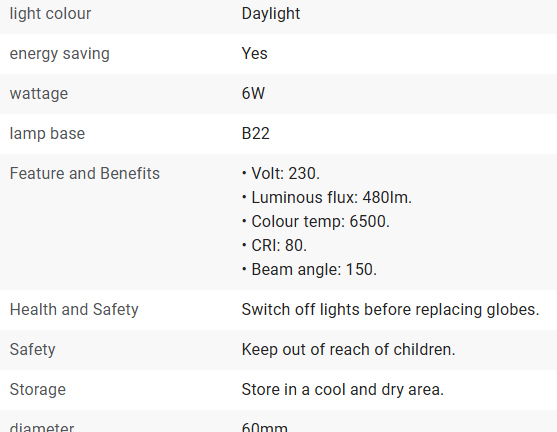
It states switch off lights before replacing bulbs and keep out of reach of children when it comes to safety.
Next, an LED module
Eurolux LED Ceiling Light Replacement Module – Warm White (24W) Builders | Lighting for Sale
The screenshot below:
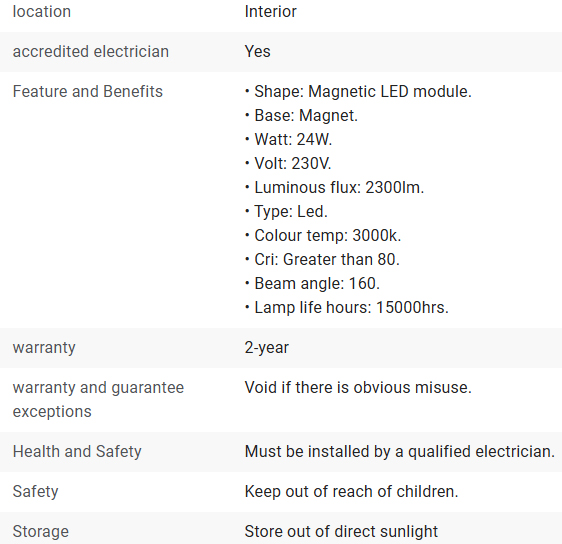
This is different than the light bulb.
Accredited electrician: Yes
Must be installed by a qualified electrician.
Keep out of reach of children.
Q: Installing a day-night switch for common property security lights?
A: Not as DIY, and not informally. This is likely to be a modification or extension of the common property lighting circuit, which falls within “installation work”. Trustees should therefore ensure it is done under the general control of a registered person, in accordance with the applicable safety standard, and that the appropriate compliance documentation is issued where required.
Q: Replace a gate motor?
A: No. If we go back to the definition of installation work, the connection of machinery at the supply terminals of such machinery;
The same applies when it comes to replacing the pool pump (and similar fixed equipment): treat it as installation work, and ensure it is done under the general control of a registered person, with the required compliance steps followed.
Q: Installing a solar light against a wall?
A: It should be yes, provided it is not connected to the mains circuit for backup power during the night or cloudy days. A simple standalone solar light consisting of a battery, panel, and an LED that is fixed to a wall does not involve the electrical installation of the complex.
As this post demonstrates, the STSMA is not the beginning and the end when it comes to sectional title schemes. In the coming weeks, there will be another post or two where a step further will be taken and look at how various Acts and Regulations will help with the running of a complex.
Electrical Installation Regulations
Explanatory Notes Electrical Installation Regulations
Disclaimer: Images are for illustrative purposes only. The information provided in this blog post is for general informational and educational purposes only and does not constitute legal, financial, or professional advice. While every effort has been made to ensure the accuracy of the content, laws and regulations in South Africa are subject to change and interpretation.
The author accepts no liability for any loss or damage that may arise from reliance on information contained in this blog. This post is not a substitute for professional legal counsel.
While the author(s) holds a Bachelor of Laws (LLB) degree, they are not a practising attorney or advocate. Reading this blog does not create a lawyer-client relationship. The law changes frequently, and information here may not reflect the most current legal developments. You should always consult with a qualified legal practitioner for advice specific to your situation.